A claim that digestive symptoms tell you whether a treatment is working can sound useful. It promises a way to interpret an experience that might otherwise feel uncertain. A treatment review may then go further, suggesting that the experience says something about the quality of a provider. Each step introduces a question that needs its own evidence.
This article examines how to read the relationship between symptoms and weight change without turning it into a service score. The central task is to keep the comparison attached to the claim: what was assigned, how an experience was classified, and which outcome the analysis was intended to estimate. Doing that allows a reader to learn from the research while recognizing when a new explanation or recommendation would require a different test.
What the random assignment actually compared
A treatment comparison begins with a decision that could have gone another way. For a causal claim, the question is what difference assigning one treatment rather than another makes. A symptom comparison asks about a characteristic of the experience that follows. The distinction matters because the characteristic may itself reflect treatment, other influences, or both. Calling both comparisons part of a trial does not give them the same meaning.
Consider the claim that digestive discomfort is necessary for a medicine to work. To assess necessity, we would need evidence about what would happen if discomfort were absent while the relevant treatment conditions remained comparable. Looking at groups who happened to have different experiences cannot, by itself, recreate that alternative. The proposed explanation changes something about the experience; the observed comparison records an experience without assigning it.
A different claim might be that discomfort identifies who will respond. That is a prediction question. It requires deciding when the prediction would be made, what information would be available then, and how useful it would be for that decision. Information learned after an outcome is already known is not automatically useful for anticipating that outcome. These distinctions keep the review focused on the proposition it is actually asking readers to accept.
A provider claim adds another comparison again. Before attributing a result to a service, identify the service feature whose effect is being claimed. The name of the medicine cannot supply that missing contrast.
What does symptom-group membership mean?
The post hoc SURMOUNT analysis grouped participants by any nausea, vomiting or diarrhea; dyspepsia was added in sensitivity analyses. One episode determined membership. SURMOUNT-1 5-mg weight changes from baseline to week 72 were −17.2% with these symptoms and −15.3% without, using modeled means. Reported error bars were standard errors. [1]
The group label is the starting point for interpretation. It tells us which distinction the analysis can make, but it does not make every experience within a category interchangeable. A reader considering everyday burden might care about interference with work, predictability, or the ability to complete ordinary activities. Those questions require outcomes that represent those concerns rather than a more convenient substitute.
The next task is to separate a group summary from a statement about an individual. A difference between summaries is not a description of every person behind them. Neither category should become a character type: the successful patient who suffers or the unsuccessful patient who feels well. Such stories attach a personal meaning to an analytical grouping, then invite readers to judge their own treatment against that story.
Precision also concerns how the number is presented. The name of an uncertainty measure belongs beside an estimate, because a reader should know what the display is intended to express. An impressive-looking chart is not a substitute for that explanation. Nor should visual proximity between estimates be described as proof of equivalence without an analysis designed to answer an equivalence question.
For a treatment review, the useful move is to keep the measured grouping visible while resisting an unsupported interpretation of what membership says about a particular person.
The analysis needs a target question
Before asking whether an estimate is convincing, decide which decision it is supposed to inform. A person considering treatment may want to understand the experience of choosing it. Someone examining its pharmacological contribution may want a more restricted comparison. A care organization may be interested in whether its entire service helps people sustain an acceptable course. These questions can overlap without being interchangeable.
The SURMOUNT design report distinguishes efficacy while treated from a treatment-regimen question that includes outcomes after premature stopping. Safety collection also extends into follow-up. These are different targets, not competing labels for the same complete experience. The program was Lilly-funded; five design-report authors were employees/shareholders. [3]
An estimand specifies the treatment question: who is studied, which treatments and outcome are compared, how events after treatment initiation are handled, and how the outcome is summarized. Stopping treatment is not identical to having a missing measurement. A sensitivity analysis asks whether an answer survives changed assumptions while keeping its target question. A supplementary analysis can ask a different question. [4]
The practical test is to complete the sentence “This number would help me decide whether…” before looking at its size. If the sentence changes when the analysis is explained, the original interpretation needs revision. That does not make the result defective. It means the reader has identified a boundary between the question answered and the question they first brought to it.
A review should make that boundary easy to find. Technical terminology earns its place when it clarifies the decision, not when it makes a percentage sound more authoritative. Likewise, agreement between different analyses is most informative when the reader understands whether they are checking the same proposition or approaching the topic from different directions.
Which observations answer the question?
Measurements after treatment stopping were excluded; SURMOUNT-2 also excluded post-rescue measurements. [1]
An average has a route into it. Measurements are collected, evaluated against an analysis rule, and summarized. Those stages should not be collapsed into a simple division between participants who counted and participants who did not. A person may contribute information relevant to one question while other information from that same person belongs to a different question.
The useful editorial task is to follow the boundary. Does the review describe the point at which information stops contributing to the estimate? Does it then ask the estimate to represent experience beyond that point? The second question is where a reasonable technical restriction can turn into an unreasonable public claim. The number may have been calculated appropriately while its description reaches too far.
There is also a distinction between an outcome that cannot be observed and an outcome that does not enter a particular analysis. Treating both as simple disappearance hides the reason information is unavailable to the reader. A careful explanation should preserve that reason. Otherwise, readers cannot tell whether an apparent gap comes from incomplete observation or from the question chosen for estimation.
For any final-visit summary, ask what would have to be true for the contributing observations to answer the intended decision. If continued participation or available measurements depend on the experience being studied, that connection deserves examination. Its direction and size cannot be supplied by intuition alone. Declaring the estimate either wholly representative or wholly invalid would outrun what this reasoning establishes.
Mediation is a model, not a randomized nausea experiment
Mediation concerned SURMOUNT-1–3, with up to 3.1% of the estimated treatment effect associated with symptoms, not body-weight percentage points. Uncontrolled post-randomization confounding and multiplicity limit inference. [1]
An association asks whether experiences vary together. A mediation question asks whether one part of an experience helps carry an effect to another outcome. That second question requires a proposed causal account. It is not answered merely by placing symptoms between treatment and weight change in a sentence or by drawing an arrow between them.
The essential challenge is an alternative that cannot be read directly from a group average: what would the outcome have been under the relevant treatment if the proposed mediator had been different? A model organizes an answer to that question through assumptions. The review must preserve the difference between an answer conditional on that account and an observation that directly settles it.
It is also necessary to specify what changing the mediator would mean. Preventing a symptom through one intervention need not represent the same hypothetical change as removing it through another. If an explanation moves from a symptom association to a recommendation for a symptom-management product, it has introduced an additional intervention. Evidence about that intervention and its consequences would be needed to justify the move.
If different causal accounts could produce the same observed pattern, a review should explain what information would distinguish them. It could ask whether the proposed explanation makes a prediction that an alternative would not, and whether the comparison can test that prediction. Until that distinction is addressed, an association would leave competing explanations open. The size of a modeled quantity would not, by itself, resolve that identification problem.
For the reader, the question is whether the review explains the causal proposal clearly enough to assess it. A percentage without that proposal is an incomplete explanation, however precise it appears.
The SURMOUNT-4 timeline changes the comparison
SURMOUNT-4 studied withdrawal after initial tirzepatide treatment. Its later randomized population had already passed through the lead-in. Lilly sponsored the trial and participated in design, conduct, analysis and writing; employee/shareholder relationships were disclosed. [2]
If a study includes several decision points, mark the time origin for each proposed comparison before interpreting its duration. Ask which alternatives could have been assigned at that moment and which experiences would already have occurred. Counting from an earlier date would answer a different timing question unless the analysis explicitly connects those periods.
The distinction is useful when a review discusses starting, continuing, switching, or stopping treatment. Each verb describes a different choice. Evidence that is well suited to one choice need not provide an equally direct answer to another. The review should keep the verb in the claim aligned with the decision the comparison was designed to examine.
An entry requirement also changes the question without making the later comparison meaningless. It may define exactly the situation a reader wants to understand. The issue is whether the claim keeps that requirement attached. Removing it in a headline can make a carefully bounded result appear to describe an experience that the comparison never set out to represent.
If a timeline were used to support a claim about cause, the reader would need more than an ordering of events. Ask what comparison separates the proposed cause from other changes over time. A sequence could help formulate that comparison, but the inference would still depend on how the alternatives were evaluated.
SURMOUNT-4 treatment phases
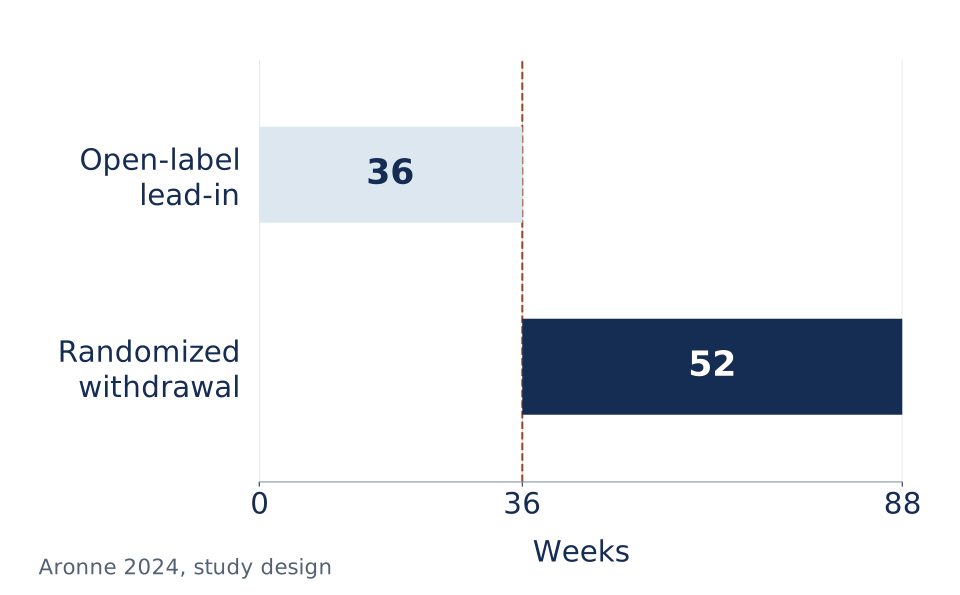
On smaller screens, scroll the chart or open the data table.
Read the chart data
| Phase | Start | End | Weeks |
|---|---|---|---|
| Open-label lead-in | 0 | 36 | 36 |
| Randomized withdrawal | 36 | 88 | 52 |
Across trials is not one interchangeable population
Combining findings requires deciding what is being combined. Shared ingredient names do not resolve differences in the question, the outcome definition, or the period represented. A review that places estimates next to one another should first explain whether the estimates address a common decision. Otherwise, the layout can suggest comparability that has not been established.
The same problem arises with symptom terminology. Before comparing two summaries, ask whether the same experience would receive the same classification in both. Then ask whether the summaries concern the same interval and the same kind of outcome. A comparison can be undermined by a mismatch at any of those points, even if the individual numbers have been copied accurately.
Consistency is still useful to examine. It can motivate a more focused question about an explanation that appears plausible in more than one setting. But the strength of that question depends on what is shared and what differs. Repetition should not be mistaken for a single larger experiment unless an appropriate combined analysis actually supplies that interpretation.
For a treatment review, the alternative to a league table is a comparison of questions. Explain what decision each result informs and where its relevance ends. This gives readers a reason to consider several sources without asking them to treat every percentage as a competing score. It also prevents differences between research settings from becoming unsupported judgments about which service delivers better care.
What evidence would evaluate supportive care?
A claim about supportive care needs an outcome tied to the support being offered. “Helped manage symptoms” could mean faster access to advice, less interference with daily life, fewer interruptions, or greater confidence about what to do next. Before evaluating the claim, choose the meaning. A general description of assistance does not establish all of these outcomes at once.
The comparison also needs to account for why assistance was used. If support is sought because an experience is difficult, a simple comparison of people who used it with people who did not could confuse the reason for seeking help with the effect of receiving help. That is a problem to address in the design, not a reason to assume assistance either succeeds or fails.
A useful evaluation would identify the service being assessed, the decision point at which people could receive it, and the experience measured afterward. It would also explain what alternative the service is being compared with. These details let readers distinguish evidence about access to support from evidence about an effect on treatment.
They also prevent an unwarranted leap from observation to a personal protocol. A description of what happened around treatment can generate questions for research without supplying instructions about how a reader should manage symptoms. A review should maintain that distinction when discussing commercial programs or additional products.
The label remains a separate safety source
Zepbound delays gastric emptying and is not recommended with severe gastroparesis. Contraindications include personal/family medullary thyroid carcinoma history, MEN2 and serious hypersensitivity. Significant or persistent digestive symptoms need clinical assessment, including pancreatitis and dehydration risks. Postmarketing obstruction reports cannot establish frequency or causality. Label safety pools and symptom-defined research groups answer different questions. [5]
Compounded formulations are not FDA-approved. [6]
Use Product identity and approval status to organize the product question, and the Peptide evidence library to examine the scope of an evidence entry. Neither link turns a general research explanation into an assessment of an individual’s suitability for treatment.
A scientific discussion should leave room for an individual experience to require attention even when it does not change the interpretation of a group result. The decision to seek care should not be treated as a referendum on whether a research paper’s main conclusion is persuasive.
An evidence standard for provider claims
Lilly funded the analysis; six authors were employees/shareholders. [1]
Disclosures help readers identify who produced the evidence and where interests may intersect. They should prompt examination of the methods and claims, not an automatic decision that every result is either trustworthy or worthless. The relevant standard remains whether the interpretation can be followed from the comparison and its assumptions.
For a provider claim, identify the service feature being credited and the evidence that evaluates it. A favorable impression from a medicine’s research cannot establish how quickly a particular care team responds, how a service handles follow-up, or what its customers experience. Those are separate questions requiring documentation or measurements suited to the feature being described.
Our How to read support descriptions guide offers a way to examine that language. The FitMetabolic review is an example of this publication’s provider-review format; consult its dated documentation for the offer being discussed. Linking a provider review does not supply evidence for an outcome comparison.
A strong treatment review makes it possible to tell where scientific evidence ends and a service description begins. It should state what would substantiate a stronger claim instead of allowing an encouraging research result to fill an evidential gap. That approach leaves readers with a more useful basis for evaluating the actual arrangement they are considering.
Questions from the reading room
What would make a symptom-based treatment claim convincing?
Start by asking whether the claim predicts an outcome, explains its cause, or describes an experience. Then look for a comparison designed for that purpose. A result should earn its interpretation through that match, rather than through the confidence of the language surrounding it.
How should I read two analyses that give different answers?
First compare their questions. An apparent disagreement may concern what each answer is intended to represent. If they do address the same question, examine the assumptions and information used before choosing the result that seems more favorable.
What belongs in an evidence-based provider review?
A clear separation between research about a treatment and evidence about the service being offered. Ask what was actually evaluated, when the documentation was checked, and what comparison supports any claimed advantage. A citation should let you inspect that connection.
Our reading of the evidence
The most useful treatment claim is one whose meaning stays intact when its evidence is examined. A reader should be able to move from the claim to the comparison, understand the outcome being summarized, and see why that comparison is relevant to the decision at hand. If a crucial step depends on an assumption, the assumption belongs in the explanation. This approach does not demand that every useful study answer every question. It allows different forms of evidence to contribute without making them interchangeable. An observed pattern can deserve investigation even when it does not settle its cause. A carefully defined treatment estimate can be valuable without describing an entire service. Keeping those distinctions visible gives a review a more demanding purpose than collecting favorable results: helping the reader decide which questions the available evidence can answer and which still need a direct evaluation.
Original sources
- Rubino 2025Diabetes, Obesity and Metabolism · Checked 2026-10-27
- SURMOUNT-4 reportJAMA · Checked 2026-10-27
- SURMOUNT designObesity · Checked 2026-10-27
- FDA ICH E9(R1)FDA · Checked 2026-10-27
- Zepbound labelDailyMed · Checked 2026-10-27
- FDA unapproved GLP-1 drugsFDA · Checked 2026-10-27