A treatment review can call an experience tolerable while leaving the reader unsure what the word means. It might refer to how often symptoms occurred, how strongly they were felt, how long they lasted, or whether someone continued treatment. Those dimensions can matter together without being interchangeable. Before accepting a reassuring description, the reader needs to know which of them was measured and how the measurement connects to the conclusion. A clear account begins with the question behind the adjective.
This article asks how a review could justify describing a treatment as tolerable. If a claim rests on recorded symptoms, we would need to examine how those records were collected and which aspect of experience they represent. If it rests on continued treatment, we would need to ask what that action tells us about burden. The aim is to make those evidentiary steps inspectable, while requiring a separate comparison for any claim about the contribution of a provider's care.
First define what the review is claiming
A statement that treatment was tolerable could mean that an experience was manageable, that participants continued treatment, or that a provider responded effectively to problems. These propositions need different observations. Before comparing reassuring descriptions, complete the sentence: tolerable according to whom, measured how, and over what period? The answer should identify an outcome that could contradict the claim as well as support it. Otherwise, almost any favorable detail could be recruited as evidence while an unfavorable detail is dismissed as measuring something else.
A claim about treatment effects calls for a comparison that can separate the treatment from other explanations. An episode description asks what a recorded experience was like. A service claim asks whether care changed that experience or its consequences. Even if all appear together in a review, evidence for one does not automatically supply the others. A helpful editorial test is to remove the product and provider names: can the reader still explain exactly what was measured and what conclusion follows?
The word also contains a judgment about acceptable burden. A report can describe an outcome without settling how much inconvenience or discomfort a reader would regard as acceptable. A review should therefore show the measurements before offering its interpretation. If it uses a broad adjective, it should say which dimensions informed that adjective and which remain unmeasured. This preserves the distinction between a finding that can be checked and a value judgment that reasonable readers may weigh differently.
A reported episode begins with an observation process
Post hoc STEP 1–3 analyses used trial-weighted percentages and a 49-day exposure window. Verbal questions and follow-up captured events. [1]
An event record is the end of an observation process. Something must happen, be recognized, be communicated, and be recorded in a usable category. When assessing a report, ask what prompts that process and when it occurs. A question asked during a contact and an entry made in a continuous diary would offer different views of experience. Neither description alone establishes completeness. The relevant issue is whether the collection method is suited to the particular burden a review proposes to describe.
Consider the difference between knowing that an episode occurred and knowing how it affected ordinary activities throughout its course. A record could establish an onset and an end while leaving interruptions to work, sleep, or plans unspecified. Conversely, a detailed account of disruption could leave the boundaries between episodes unclear. These are different measurement gaps. A reader should look for the actual question or outcome definition before assuming that a recorded event contains every dimension implied by the word tolerable.
Timing also determines which experiences an analysis is permitted to include. An observation window gives a counting rule; it does not establish what happened outside that rule. For any report, place that boundary beside the conclusion and ask whether the conclusion extends farther. If a publication combines observations from several trials, examine its weighting rule before reading a displayed percentage as a simple share of everyone enrolled. The method should explain what the combined estimate represents without requiring the reader to reconstruct it from a headline.
People and episodes carry different information
Among 2,116 semaglutide-exposed participants, 1,562 reported 6,993 gastrointestinal events; 99.5% were nonserious and 98.1% mild/moderate. [1]
Counting affected people answers whether someone crossed the threshold for inclusion in an event category. Counting episodes asks how many qualifying occurrences were recorded. For a recurring experience, those questions need separate answers. An affected-person total does not show whether experiences were concentrated among a small subset or spread more evenly. An event total does not by itself identify the number of people who experienced them. Dividing one total by another would produce an average, while leaving that distribution unresolved.
Categories introduce another distinction. A participant could contribute to several symptom categories, and several categories could describe experiences occurring during overlapping periods. Adding category percentages would therefore require information about overlap before the sum could represent distinct people. The same caution applies to event counts: a larger total could reflect more affected people, more occurrences per affected person, or differences in how an occurrence was divided into records. To decide among those possibilities, a review would need the corresponding observations rather than a more emphatic adjective.
The unit attached to a classification matters as much as its value. If a percentage describes events, reading it as a percentage of people changes the question. A person-level description would need a rule for handling someone whose episodes fall into different categories. The reader should be able to follow that rule from the table heading to the review sentence. Keeping people, episodes, and classifications separate also prevents an event summary from becoming an unsupported portrait of the typical participant.
Nonserious does not mean inconsequential
Severity describes intensity; seriousness concerns consequences. [1]
A classification can be accurately reported and still be used to answer the wrong question. If a review treats the absence of a particular outcome classification as proof that an experience barely mattered, it has added a claim about comfort that needs its own measurement. The useful response is to ask which question the classification was designed to answer. Its value does not disappear when its scope is narrow; the mistake is expanding that scope without additional evidence.
For an assertion about daily interference, look for an outcome that actually captures interference. A category name alone cannot tell the reader whether responsibilities were interrupted, whether plans changed, or how burdensome an experience felt. Those questions should remain open unless the report measures them. Equally, a review should not substitute an imagined worst experience for missing information. The appropriate interpretation keeps the recorded classification intact while identifying the separate outcome that would be needed to support a statement about everyday functioning.
Comparisons become clearer when each label remains attached to its definition. If different reports use different classification rules, matching the words in their summaries would be insufficient to establish comparable outcomes. A careful comparison would inspect how categories were assigned, how changes over time were handled, and whose assessment was recorded. These checks concern the meaning of the measurement rather than an assumption that one report is more reassuring. They allow a reader to evaluate whether the same adjective carries the same evidentiary content across reviews.
An episode median leaves the rest of the experience open
Read a duration plot as a display of a particular summary. Spacing along a time axis can help compare episode summaries without ranking the total burden experienced by different people. A median describes a position in a distribution; it does not mark the end of every episode, the longest episode, or a deadline by which an individual experience must resolve. The unit shown on the plot should determine the comparison being made.
A longer displayed median would support a statement about that summary of duration. To turn it into a statement that a symptom was more disruptive overall, a reader would also need information about intensity, frequency, and the relationship between episodes. Likewise, a shorter median would leave open whether an experience recurred. The visual comparison is useful precisely when the claim stays aligned with the axis and unit shown, instead of allowing the most prominent point to stand for an entire treatment experience.
Time spent with symptoms requires a further accounting decision. If different episodes overlap, adding their durations could count the same calendar day more than once. If episodes recur, a summary of individual episodes would not directly describe each person's accumulated time. An analysis intended to answer that question would need to identify people, connect their records, and specify how overlap is handled. If a proposed display summarized only episodes, predicting a person's accumulated symptom days from it would require additional information about how those episodes were distributed within individuals.
Uncertainty should also be distinguished from the location of a plotted estimate. A dot drawn at a precise position does not establish comparable precision in the underlying estimate. When an interval is absent, avoid inventing its width in either direction. Ask what uncertainty the report quantifies and what remains undescribed before treating the display as a personal forecast.
STEP episode duration
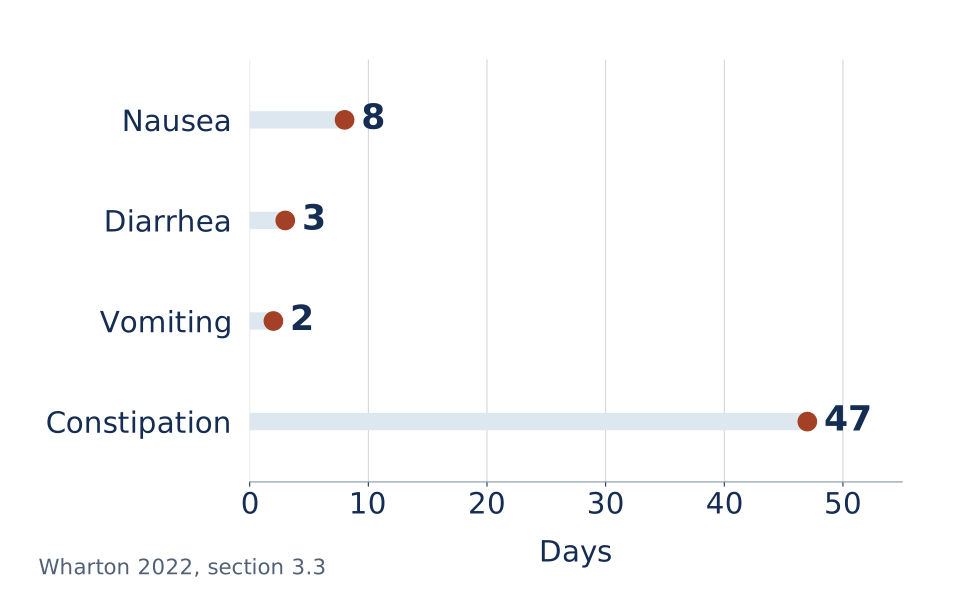
On smaller screens, scroll the chart or open the data table.
Read the chart data
| Symptom | Median days |
|---|---|
| Nausea | 8 |
| Diarrhea | 3 |
| Vomiting | 2 |
| Constipation | 47 |
Stopping treatment is an outcome, not a verdict
Gastrointestinal events prompted permanent stopping in 4.3% versus 0.7% with placebo. [1]
A stopping outcome needs a reason, a treatment boundary, and a follow-up boundary. A permanent stop attributed to a specified event answers a narrower question than stopping for any reason. A temporary interruption belongs to a different category again. When a review uses the word discontinued, the reader should be able to identify which action it describes. Otherwise, figures that appear inconsistent may be answering different questions, or an apparently reassuring comparison may have silently excluded the outcome the reader intended to understand.
Remaining in a study and continuing a treatment also need separate records. A participant could contribute follow-up information after a treatment change, while a missing assessment would leave an outcome unknown regardless of the treatment record. For an analysis of stopping, ask whether the report preserves that distinction and explains how reasons were collected. A reason should not be supplied by the reviewer simply because it seems plausible. The recorded category is evidence; an unrecorded motivation is an additional explanation that would need investigation.
Continuation is informative about what people did under the conditions being studied, but it is an incomplete measure of what they experienced. If a review wants to interpret continuation as satisfaction or ease, it should look for direct evidence of those judgments. If it wants to interpret stopping as a complete assessment of the treatment, it should explain why that action captures the whole question. A more useful analysis treats stopping as one outcome alongside experience, leaving the relationship between them available for examination.
Why maintenance evidence starts after a selection step
STEP 4 randomized only participants still taking the target semaglutide dose after its run-in. The maintenance comparison therefore answers a continuation question among selected participants. Adverse-event evaluation used a 49-day exposure window and counted new onset after randomization. [2]
For a continuation question, prior treatment experience is part of the starting point. The relevant comparison begins when the next choice becomes available. An initiation question begins earlier and asks about the course from a different decision point. Drawing these starting points separately helps prevent a later comparison from answering a question about the entire pathway. This is a distinction about treatment history, even before considering any broader question about who volunteers for research.
Random assignment can make a comparison informative within its defined starting conditions without erasing the path required to reach them. To interpret a maintenance study, read the eligibility rule alongside the decision it is designed to inform. Then ask what information would be needed about earlier stages to construct an account of starting and continuing treatment. The existence of a useful later comparison does not automatically supply the missing earlier comparison, nor does that boundary make the later question unimportant.
The origin of the observation clock matters here as well. A report might distinguish a newly beginning event from an experience already underway at the comparison's start. Those rules would describe different outcomes under the same broad label. Before combining phases into a single narrative, verify that event definitions and time boundaries line up; otherwise the story could join measurements designed to answer separate questions.
How should an efficacy question be defined?
The original report distinguishes treatment-policy and trial-product questions. [2]
For any efficacy estimate, begin by asking whose measurements contribute and how treatment changes affect inclusion. A question about the outcome while treatment continues and a question about the outcome following an initial treatment decision can require different information. A review should identify its intended question before selecting whichever estimate looks most favorable. The handling of treatment changes belongs to the meaning of the answer, alongside the outcome and comparison being reported.
An analysis of symptoms and an analysis of weight need not use identical observations. Before connecting their results, check whether the same people, time periods, and inclusion rules are represented. If an analysis were restricted to people still treated at a later assessment, a conclusion about everyone who started would require additional reasoning. If people were grouped by an experience observed after treatment began, that grouping would need to be distinguished from assignment to treatment.
The next step is to separate description from explanation. Seeing different outcomes in groups defined by experience would invite a question about why they differed; it would not settle that question. A causal account would need to address alternative explanations and the order of events. For this tolerability discussion, the boundary is enough: an efficacy result should not be used as a substitute measure of comfort, and a symptom description should not be treated as an explanation of efficacy.
Current safety language limits historical reassurance
For this October 27, 2026 reading, place present safety information beside historical evidence. A review should preserve the wording and product identity relevant to the claim rather than extending an older summary by assumption.
Wegovy delays gastric emptying and is not recommended with severe gastroparesis. Contraindications include personal/family medullary thyroid carcinoma history, MEN2 and serious hypersensitivity. Persistent or severe abdominal pain needs prompt assessment for pancreatitis; vomiting or diarrhea can cause dehydration and kidney injury. Postmarketing obstruction reports do not establish frequency or causality. These STEP data concern weekly 2.4-mg injections, not every current Wegovy presentation. [3]
Compounded formulations are not FDA-approved. [4]
Use Product identity and approval status to examine medication terminology and the Peptide evidence library to frame evidence questions. These distinctions keep a broad ingredient discussion from silently becoming a conclusion about every product bearing its name.
What a treatment review can responsibly conclude
Novo Nordisk funded the trials and writing support; three authors were employees/shareholders. [1]
Novo Nordisk funded the study and participated in its design, conduct, analysis and writing. [2]
Funding and involvement belong in the reader's appraisal of how evidence was produced. Disclosure should prompt examination of the analysis question, reporting choices, and access to methods. It does not replace those checks with an automatic favorable or unfavorable verdict. A reader can recognize an interest in the result while still asking whether a particular comparison supports a particular conclusion. That is more informative than using a sponsor label as a shortcut for judging every finding.
A claim that a provider improves tolerability would need evidence about the provider's care itself. A defined service comparison, comparable follow-up, and an outcome that measures the claimed improvement would make the claim testable. If the service includes several elements, the interpretation should specify whether the evidence evaluates the whole arrangement or an individual component. These are requirements for supporting a claim, without presuming that any particular service succeeds or fails.
For service terminology, consult How to read support descriptions. The FitMetabolic review offers an example of a provider-review format; check dated provider documentation when assessing its descriptions. Linking that review does not mean these studies evaluated its service. Keep research conclusions attached to the studied treatment question, and require separate evidence before attributing an outcome to the organization providing care.
Questions from the reading room
Does this claim concern affected people, episodes, or time with symptoms?
Look for the unit attached to the result and retain it in the conclusion. If the review changes units, ask what additional observations support that change in meaning.
What does the review mean by tolerable?
Identify the outcome the adjective summarizes. Then ask whether the judgment requires information about disruption or acceptability that the report has not explicitly included in that outcome.
What evidence evaluates the provider's care itself?
Look for a comparison tied to the named service and the improvement being claimed. Product research alone cannot identify which part of a service, if any, contributed to an outcome.
Our reading of the evidence
A useful tolerability assessment keeps frequency, intensity, duration, and treatment decisions visible as separate dimensions. The reader should be able to move from an adjective to a defined outcome, from that outcome to an observation process, and from the observation to the comparison that supports the conclusion. Where a step is missing, the review should identify the missing evidence rather than complete the chain with reassurance. This approach also leaves room for different judgments about acceptable burden without confusing those judgments with measured facts. The strongest conclusion is therefore one whose scope can be inspected: it explains what was counted, whose experience the comparison addresses, and which question remains open. That makes the evidence useful for evaluating a claim while preserving the uncertainty that a single score would conceal.
Original sources
- Wharton 2022Diabetes, Obesity and Metabolism · Checked 2026-10-27
- STEP 4 reportJAMA · Checked 2026-10-27
- Wegovy labelDailyMed · Checked 2026-10-27
- FDA unapproved GLP-1 drugsFDA · Checked 2026-10-27